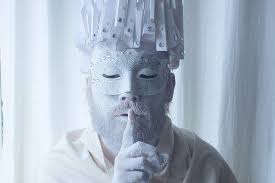

What if the exhaustion you feel isn’t about doing too much but about overriding your natural impulses and authenticity for too long?
Most of us learned young that certain parts of ourselves were acceptable and others needed to be hidden. We shaped ourselves around what our primary attachment figures could hold, what our culture rewarded, and what kept us safe and belonging.
We built multiple masks, they became normalized, and then we forgot we were wearing them.
Performing and Perfectionism is a Full-Time Job
There’s a type of tired that no amount of resting or sleep repairs. It lives in the tension of our jaws, shoulders and chests. Also, our breath that is barely audible no matter how many we go to yoga and learn to exhale deeply.
Canadian Jungian analyst Marion Woodman called perfectionism a spiritual crisis. Not a personality flaw, or a productivity problem; a crisis of being cut off from the truth of what it means to be human. She saw it as a war against the body itself. Against the parts of us that hunger, ache, need, and fail.
The achiever, the people-pleaser, the perfectionist, these aren’t defects to be resolved, they’re your protectors. These masks learned very early on, that performing was safer than being who you are. That accommodation kept the peace. That being good enough might finally earn you the love and rest you were deserving of.
But the nervous system can’t discharge what’s always being held in. It can’t rest when it’s always turned on. Chronic performing keeps the body in a state of low-grade vigilance. Held breath, forced smiles and nodding while something inside contracts. These are all signs of the old masks in place.
This is an origin of where exhaustion actually comes from. It’s not weakness. It’s the cost of a costume worn too long.

Culture Hands Us the Mask Early
We don’t make up our masks from out of nowhere. Our culture and families summon us to wear them before we’re old enough to question what we’re being asked.
Western culture has long prized the measurable: productivity, achievement, rational thinking, and spiritual perfectionism. What it tends to quietly devalue are the things that can’t be optimized: the body, emotion, rest, need, and receptivity.
For many women, in particular, the conditioning runs deep: be agreeable, be small, be useful. Don’t take up too much space. For men, the message is different but equally constricting: be strong, don’t feel, and be productive. Keep it together.
Somatically, this early conditioning often settles into the body and stays there, e.g. a collapsed chest, frozen pelvis, tight jaw holding words that were never safe to speak. The mask doesn’t just sit on the face. It moves through and lives in our tissues.
And sometimes it shows up in more visible ways, like disordered relationships with food, with the body, and with control itself. Woodman was particularly clear on this: the drive to perfect, discipline, and erase the body’s hungers comes from a culture that told us the natural body, with its needs, cycles an animal aliveness, needed to be corrected.
Healing begins with asking: who told you that?
The Body Is Already Telling the Truth
Here’s something worth reflecting on. Your body hasn’t been performing this whole time. It’s been responding honestly to everything your mask has asked you to manage.
The swallowed truth lives in the jaw and the throat. The grief that never had room sits in the chest. The instincts that were overridden settle in the belly. The body holds what the mask was trying to conceal, not as punishment, but as memory.
It tracks authenticity in real time. When something is true for you, there’s a quality of openness in it, an expansion, a sense of connection. When something isn’t, you can feel the pull inward, the contraction, the body’s quiet refusal to agree.
Learning to listen to this is not soft or indulgent. It’s a precision instrument.
Saying no when you mean no, and feeling the regulation that comes from that instead of the temporary relief of accommodation, is one of the most concrete experiences of what it means to be embodied. The boundary that comes from the body isn’t a performance of self-care. It’s the self, speaking plainly.

What Becomes Possible When the Mask Comes Off
Woodman wrote that without boundaries, a person gradually disappears into service of others and forgets she had a center at all.
Many people discover this not through crisis, but through the quiet accumulation of symptoms: constant fatigue, inability to digest food, disconnection from others they can’t explain. The sense of moving through life as though watching it through glass.
The authentic self isn’t a destination to arrive at, or a version of ourselves that has everything sorted out. Authenticity is a moment-to-moment practice of returning to our gut sense of who we are and what and who we choose to be from that place. Noticing when we’ve drifted into performing instead of connecting, and choosing, again, to return.
What that return feels like in the body is immediate. The breath deepens, shoulders drop, chest opens. We know.
When we connect we know that our hunger and tiredness matters. Our grief and joy both deserve space. Our body’s signals are worth organizing our lives around.
That is not a luxury. That is what it means to be unapologetically, freely, alive in a body.
Want to explore what living from your authentic self feels like in your body, nervous system, and life? This is the heart of the work we do in the School of Sacred Somatics. Find out more at jayahollohan.com. ✨