
What if the very practices meant to help you heal have been helping you to avoid it instead?
That may not be a comfortable question but it might be the one we need to ask ourselves.
There’s a particular kind of spiritual seeker who meditates daily, speaks about love and light with genuine warmth, extends grace to almost everyone, and is quietly, persistently running from something they haven’t yet been able to name. They’re not doing it on purpose. They’ve simply found that rising above pain is much more manageable than delving into it.
The problem is that what you rise above doesn’t go away. It quietly waits in the corners of our mind and tissues of your body until they are stressed enough for it to surface.
When Spirituality Becomes a Strategy
Psychologist John Welwood named this pattern in 1984. He called it spiritual bypassing: using spiritual practices and beliefs to sidestep painful feelings, unresolved wounds, and developmental needs that still require attention.
The tricky thing about bypassing is that it looks good. It presents as peace, acceptance, gratitude, non-attachment. On the surface, it can be hard to distinguish from genuine spiritual development. But underneath, there’s often a telltale quality: a kind of floatiness, a struggle to tolerate anger, a sense that the body is beside the point.
Bypassing can look like constant positivity that doesn’t quite reach the eyes. It can look like compassion so boundless it has no capacity to say no, to be angry, or to draw a line. It can look like spiritual credentials that substitute for the harder work of processing the backlog of emotions we may have stuffed since we were children.
It sounds like: “I’ve moved past that.” “Everything happens for a reason.” “I’m choosing love.”
It doesn’t mean these statements are false. It means something in the body, or related passive aggressive behaviours, are often telling a different story.
What Gets Left Behind
When we bypass, we don’t just skip over pain. We skip over unintegrated sensation, emotion, memory, and behavioural information.
The nervous system stores everything that hasn’t been processed. Grief that was labeled “negative thinking.” Anger that was reframed as “an invitation for compassion.” Fear that was dissolved in meditation before it had a chance to say no.
These experiences don’t disappear. Their unintegrated charge accumulates within the nervous system over time, and the body, as always, keeps the score.
Spiritual bypassing doesn’t only show up in spiritual communities. It travels in the same company as: people-pleasing, e.g. the habitual extension of grace to everyone except yourself; perfectionism, e.g. the relentless pursuit of a self that needs no healing; and intellectual bypassing, e.g. the endless analysis of your experience as a way of not quite having to feel it.
All bypasses, whether spiritual, positivity-based, or people-pleasing, share the same root: the preference for leaving over staying, for rising above rather than descending into what is here. Because what is here is simply too overwhelming to feel.
Compassion Without a Body
Here’s what’s rarely said about spiritual bypassing: it often comes from a genuine longing for healing. The turn toward light, love, something larger than the wound; usually one that Western medicine or talk therapy couldn’t heal.
That impulse is not the problem. It is the bypassing the body on the way there that is.
Real compassion, the kind that doesn’t collapse under pressure, has weight to it. It knows how to hold both the tenderness and the difficulty. It can be present with pain without immediately trying to transform or transcend it.
That kind of compassion isn’t learned in the mind. It’s learned in the body. In the slow, sometimes uncomfortable practice of staying with what’s here: the tension, numbness, grief, anger, and the ordinary ache of being human; without rushing toward resolution.
Tara Brach says, “Radical compassion is an all-embracing tenderness that moves toward our suffering first, then others, rather than away from it. It is embodied, active, and all-inclusive, not a feeling we perform or a state we claim to have arrived at.”
This experience stands in direct contrast to Marion Woodman’s description of the “inner critic or disembodied spirit, which judges us as fundamentally not enough and drives us further into bypass, e.g. the addiction to transcendence or fleeing into spirit, beauty, and light rather than having to face the shadow, messy, imperfect human.”
Exercise: Are You Here, or Are You Above It?
This one asks something of you for a few moments of honest contact with ourselves.
Find a comfortable position. Both feet on the floor if you’re sitting. Take a breath, inhaling and exhaling.
Think of something in your life that you’ve made peace with. Something you’ve reframed, released, or risen above. Hold it lightly in your mind.
Now drop your attention into your body.
Start at your chest. Does it feel open and settled, or is there something faintly braced there, a subtle holding?
Move to your belly. Soft, or quietly contracted? Is there any tension that wasn’t there a moment ago?
Notice your throat. Any tightness? A sense of something that hasn’t quite been said?
Maybe something that has been waiting to finally surface while you check in.
Ask yourself this question: Is the peace you found about this issue something that landed in you, or something you climbed to?
Landing has a quality of weight to it, e.g. feet on the ground, and something settling rather than something being set aside.
Climbing feels lighter, which isn’t always wrong. But the body usually knows the difference.
Whatever you notice, stay with it for one more breath. Not to fix it. Not to reframe it. Just to let it be seen and felt until it naturally finds its way into integration.
That’s the practice. Staying just a moment longer than the urge to rise above the challenging emotions and sensations.
Embodied Spirituality
We can invite both the human body and its messiness, alongside the divine nature of its Spirit to live together in harmony.
Thomas Hübl shares about the difference between having spiritual insights and understanding and spiritual embodiment. Insight arrives quickly, and embodiment takes time. It asks the nervous system to let what we understand actually land as part of embodied wisdom.
Giving human pain its actual due before asking it to transform, often feels opposite to what we expect. Not dissolution or peace, but a kind of landing. A feeling of weight returning, and our feet actually touching the ground.
Like Miriam Greenspan shares, “The emotions of fear can become clarity, grief can become compassion, and despair can become hope.” What felt like a dead end, becomes a threshold for integrated evolution.
What remains, when we stop running, is almost always the doorway into embodying our greatest home.
For a 3-minute YouTube video on the same subject click here.
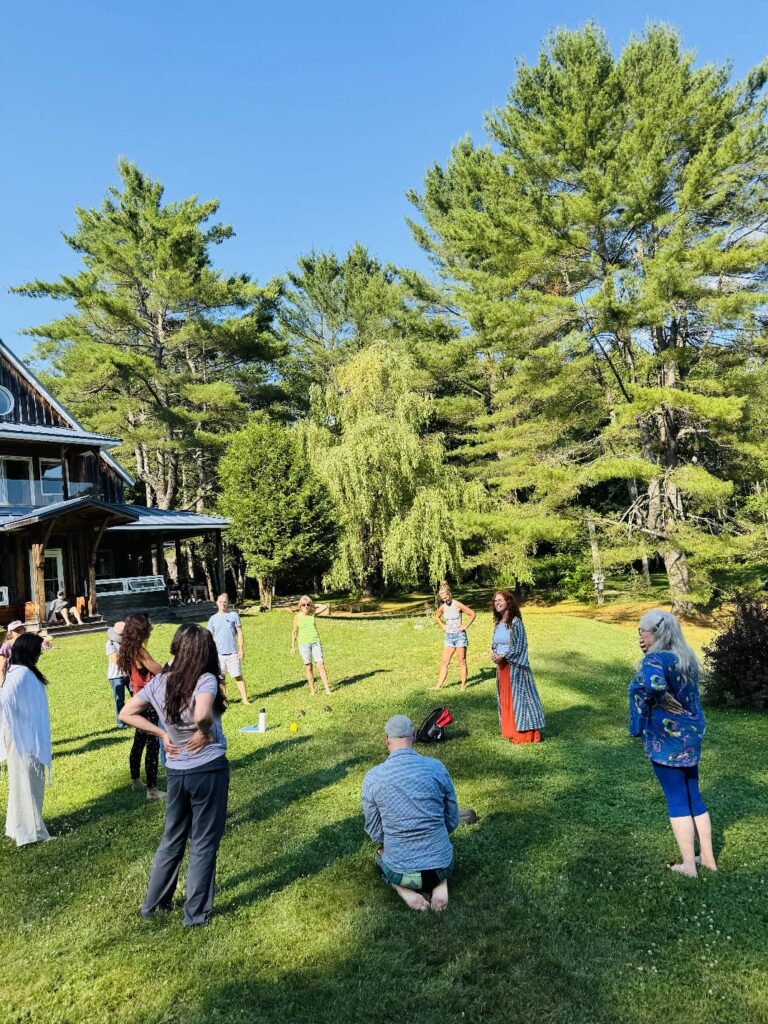
This kind of embodied, honest healing is what we practice in the School of Sacred Somatics, as well as in our Retreats. If you’re ready to stop rising above and start going through, join us in early July 2026 near Ottawa, Canada for a 4-day Retreat or in Ubud, Bali in mid-December 2026 for an 8-day deep dive. Find out more at jayahollohan.com. 🍃